Anuj Puri, Chairman – ANAROCK Property Consultants

The landmark reform of Goods & Services Tax (GST) was, in many ways, the final bullet shot to the Indian real estate sector in July 2017. The industry was already reeling under the immediate impact of DeMo and RERA.

GST was touted to be a gamechanger for all sectors including real estate. It was largely anticipated that GST will provide a much-needed respite to homebuyers by way of reduced property prices. Unfortunately, with GST completing one year, it emerges that these expectations were unrealistic.

While the tax-on-tax has been eliminated with the advent of GST, the overall outgo from homebuyers’ pockets seems to have increased by as much as 8% across cities. This ultimately reduces the demand in real estate.

Also, the higher tax rate on purchasing a home – an already staggering expense for most Indians – has kept many home buyers and investors off the market.

Let’s understand this better.

  • In real time, the cost of raw materials under the GST regime underwent minor changes – cement, paints and plasters were taxed at 28%,

Anuj Puri, Chairman – ANAROCK Property Consultants

Home loans are paid in instalments which are commonly known as Equated Monthly Instalments (EMI). These are fixed amount which is expected to be paid by the borrower to the bank every month as a part of loan repayment.

A bank considers a home loan to be in default when the borrower fails to make a payment and is behind by 90 days. In such a case, the borrower would have missed 3 payments of EMI.

When the home loan is in default, banks do not seize the assets of the borrowers immediately. They send a notice to the borrower stating that the EMI payment has been missed and strict action will be taken in this regard.

Banks are ready to understand the various reasons behind non-payment of the EMIs, which might include financial crisis, accident, etc. if the borrower approaches the bank with an explanation.

Once the reason is conveyed by the borrower or is otherwise evident to the lender, the bank restructures the EMI and extends the loan tenure on the request of the borrower.

Prashant Thakur, Head – Research, ANAROCK Property Consultants 

Project delays are one of the most alarming issues historically dogging the Indian real estate sector.

The dearth of effective planning and execution of construction activities, escalating construction costs, approval delays, diversion of allocated funds to other projects and tepid sales are some of the predominant factors resulting in project delays. The homebuyer is, of course, at the losing end.

To put it in numbers, during 2017, out of the total 5.8 lakh residential units slated to be completed across the top 7 cities in India, only 1.5 lakh units were actually delivered until December 2017. This indicates that around 4.3 lakh units actually missed their stipulated completion deadlines.

The National Capital Region (NCR), one of the country’s largest residential markets, was seriously wounded by sudden policy changes, structural reforms – and the dubious practices of unscrupulous developers.

As a result, it topped the list of cities with maximum project delays. Around 1.5 lakh units in NCR missed the 2017 deadline. The story in Mumbai Metropolitan Region (MMR) was no different with nearly 1.1 lakh units missing the said deadline.

Anuj Puri, Chairman – ANAROCK Property Consultants

The housing ministry’s decision to tweak the eligibility criteria for MIG-I and MIG-II home buyers for houses eligible for interest benefit under PMAY is a phenomenal move to boost sales of large-sized apartments.

As per the revised norms, MIG-I category home buyers with household income between ₹ 6 lakh – ₹ 12 lakh are now eligible for a subsidy for homes up to carpet area of 160 sq. m. from the earlier 120 sq. m.

Similarly, MIG-II category home buyers with household income between ₹ 12 lakh – ₹ 18 lakh are also eligible for a subsidy for homes with a carpet area of up to 200 sq. m. from the earlier it was 150 sq. m.

This change will have a significant impact on home sales in tier II and tier III cities where the land costs and therefore capital values of properties are low and larger apartments are within the reach of such buyers.

The timing of this increase in carpet area eligibility norms is perfect, as the RBI recently decided to revise the housing loan limits for Priority Sector Lending (PSL).

Prashant Thakur, Head – Research, ANAROCK Property Consultants

Located in south-eastern peripheries of Pune, Undri was once a small and unremarkable village outside the Pune municipal corporation limits. After opposition from residents regarding merging of Undri into the Pune Municipal Corporation (PMC) in 1997, it was demerged in 2002.

In 2017, Undri came under the purview of the Pune administrative authority – Pune Metropolitan Region Development Authority (PMRDA). Many residents of the region, whose primary occupation was agriculture, sold their land parcels to private real estate players, thus paving the way for rapid growth of residential and commercial developments in Undri.

Surrounded by micro-markets such as Hadapsar, Pisoli, and Handewadi, Undri offers relatively serene surroundings with thick green cover. It has good social infrastructural facilities including educational institutions, healthcare facilities, and entertainment options.

Various IT-ITeS establishments including Magarpatta City in Hadapsar, Eon Free Zone in Kharadi and SP Infocity in Phursungi have created massive residential demand in and around the regions, eventually hiking property prices in these areas.

Undri caught the spill-over demand from these nearby markets with its relatively lower property values.

Anuj Puri, Chairman – ANAROCK Property Consultants

‘Small is beautiful’ is the new buzzword with Indian millennials when it comes to buying homes in cities like Mumbai.

These young professionals are less focused on size and look for homes in locations close or well-connected to their workplaces so that their daily commute is reduced and work-life balance is maintained. Compact homes are also low on maintenance expenses and are invariably very budget-friendly in all respects.

With the ever-increasing rents in a city like Mumbai, buying a compact home is also a very suitable option for several new citizens. Taking a small loan and paying up the monthly EMIs on an investment-grade asset which can be easily resold is seen as preferable to shelling out hefty rents.

On the back of this trend – and the prevailing market sentiment which is averse to overly heavy investments into residential property – apartment sizes in the Indian metros are definitely shrinking as developers increasingly deploy affordably-priced homes for which the demand is currently the highest.

In fact, apartment sizes have already reduced significantly enough to justify any and all measures that help maximize the usability of the available spaces.

Santhosh Kumar, Vice Chairman – ANAROCK Property Consultants

Despite being hit by the overall slowdown in the real estate market and seeing price corrections up to 10% in most areas, Delhi-NCR continues to be attractive to end-users and investors. Being the national capital, Delhi attracts migrants from all across the country.

In fact, as per the Economic Survey of 2017, Delhi, Noida, Greater Noida and Gurugram saw the maximum influx of migrants between 2001 and 2011. Obviously, there is a dire need to fulfil the housing needs of these migrants.

As per ANAROCK data, the housing supply in Delhi over the last two years has been fairly low as compared to its counterparts – Gurugram and Noida. This is essentially due to demand-supply mismatch; there is massive demand for affordable housing in the city, while property prices in most pockets of the city have skyrocketed.

Consequently, the pockets that offer affordable or mid-segment projects have been performing relatively better than the expensive ones – such as Greater Kailash II, Panchsheel Park and South Extension II, to name a few.

In 2018 as well,

Prashant Thakur, Head – Research, ANAROCK Property Consultants

After a year-long delay, the final draft of Greater Mumbai Development Plan (DP) 2034 recently saw the light of day.

The highlights were the amendments in the development control regulations (DCR) in terms of increased FSI and the opening of the salt pan lands for construction of affordable houses, which are now the talk of the town.

DP 2034 visualizes Greater Mumbai as a ‘competitive, inclusive and sustainable city’. It goes without saying that decongesting the city must be a prime focal point in such an agenda.

Accordingly, the Municipal Corporation of Greater Mumbai (MCGM) has decided to utilize the city’s huge tracts of salt pan lands for affordable housing projects.

A total of 3,355 hectares of salt pan lands are spread across MCGM in Dahisar, Goregaon, Mulund, Bhandup, Kanjur, Nahur, Ghatkopar, Turbhe, Mandale, Chembur, Wadala and Anik.

These lands, which were classified as salt pan lands and no development zones (NDZs) for decades are now open for new development.

According to the final draft of DP, 2,100 hectares of salt pan lands are now demarcated for the construction of 10 lakh affordable housing development,

Santhosh Kumar, Vice Chairman – ANAROCK Property Consultants

You read of it in advertisements and on hoardings, and hear of it in radio jingles and TV commercials – the ideal home, or ‘dream home’.

It makes you wonder if you’re living the lifestyle you truly deserve, if your previous home purchase decision was too hasty and if there is a chance you could do better.

The ‘ideal home’ is a ubiquitous marketing concept, and it haunts buyers before and after a property purchase. But is there really such a thing in India?

The ‘Ideal Home’ Paradox

By and large, the concept of an ‘ideal’ home is very relative in this country. While everyone carries a picture of their dream home in their hearts, that image usually cannot translate into reality in this country.

People long to stay close to nature, yet also close to the excitement and opportunities of the city. They long for a home in an environment unpolluted by noise and vehicle emissions, yet depend heavily on public transport and roads to use their personal vehicles for commuting to and from work.

Addition of nearly 6,800 new units marks 127% increase over previous quarter 

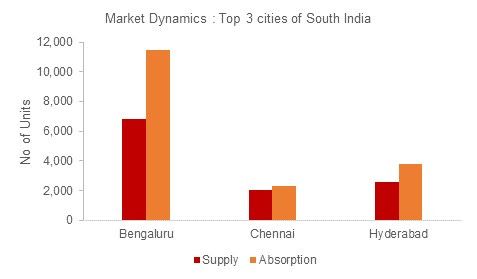
Emerging as the front-runner in the major South Indian markets in terms of new housing supply infusion, Bengaluru saw significant growth in new housing launches as well as absorption in Q1 2018.

In fact, Bengaluru saw highest launches among these markets with nearly 6,800 new units supply in comparison to Hyderabad and Chennai, which saw the launch of 2,600 and 2,100 units respectively. Bengaluru also leads on the absorption front, with a total of 11,500 units sold in Q1 2018. 

“Increased commercial activity, positive buyer sentiments, infrastructure upgrades and improved job opportunities in the city have given a major fillip to Bengaluru’s housing market,” says Anuj Puri, Chairman – ANAROCK Property Consultants. “This market is largely driven by the end-users who were in a wait-and-watch mode so far. These buyers have now actively returned to the market on the back of the overall sentiment upsurge resulting from the Bengaluru’s rapidly improving market fundamentals.”

Supply & absorption trends – Bengaluru, Hyderabad & Chennai

Bengaluru realty on an upswing 

“Even at a pan-India level,